Ourgrations
Afghanistan: Rebuilding a Nation
 Even though the fall of the Taliban in 2001 marked the beginnings of a new government and way of life for the Afghani people, this transition left the land desolate and the economy destroyed. Afghanistan begin in a situation that left them nearly hopeless when relying on their own resources. Much reform is needed now that the oppressive Taliban has been abolished, but cannot be addressed until homes are rebuilt and jobs are established. Foreign monetary assistance along with programs designed to help the local villages are the most effective in helping to build a new Afghanistan.
Taking down the Taliban did not merely result in the fall of a government, but the decimation of houses, neighborhoods and businesses as well. When the Taliban was suspected of the Twin Tower attacks and refused to hand over Bin Laden, the US swiftly led a bombing attack on Afghanistan that was destructive enough to convince the Taliban to relinquish their title as governing political party ("Afghan Turmoil", par. 4).
With the new hope of a fair and effective government, millions of refugees returned to their native land, only to find their homes either ransacked by insurgents or in ruins. Sultan Jan, a returning refugee, experienced this situation firsthand upon his return to his homeland of Afghanistan. This sad situation can be seen in the case of Sultan Jan. He returned to Afghanistan not long after the fall of the Taliban from a refugee camp in Pakistan. He returned with a hope of receiving land and a house so that his wife and nine children would have a place to live while he went out to work and earn a living. Unfortunately, he was very disappointed. The reality of his situation is that he is living in a makeshift tent that was provided by the United Nations High Commissioner for Refugees (UNHCR) with all of his family and all their belongings. He works for an average of two to three dollars per day taking on whatever labor he can find. (www.youtube.com/watch?v=mmG2bH3YQVc) He may be just one of five million refugees returning to Afghanistan, but his disheartening situation is similar to many others. While it is a hopeful sign that citizens are returning, refugees, like Sultan, don’t have the money to build a permanent home on an income of $600 per year. The immediate needs of his family need to be met. While the refugees save up money and receive help from the government (only those who are in the most destitute situations receive government help), they do not bring in the revenue needed to fund reconstruction. They need money in order to start any entrepreneurial ventures that will bring in revenue to the country to pay the taxes that can build up the nation. This is where outside aid becomes imperative.
In the case of Germany’s Post-World War II reconstruction, foreign aid played a vital role in rebuilding the land and subsequently, the economy. Germany was left in complete disarray:leveled neighborhoods , destroyed government offices as a result of bombing raids and a stymied job market in need complete conversion from war production to consumer needs. With their defeat came an economic halt, not unlike Afghanistan’s situation. Both nations, after breaking free from their governments, needed to create jobs in order to rebuild the country. However, the same country that needed to create the jobs needed to rebuild the country-- enough to house the jobs-- in order to jumpstart the economy. In Germany's situation, the US and allies responded quickly to rebuild the nation, all with the objective of preventing another corrupt government system from taking power during this period of vulnerability. The intent of the Marshall Plan was to “promote economic recovery” (Serafino,Tarnoff, and Nanto 7). In terms of 2005 dollars, 9.3 billion dollars were donated to Germany in the name of reconstruction. The money paid for food aid in the beginning, and then went towards the industries such as coal, cotton, steel factories etc. to build the economy. While this all was given to help Germany, it was not with the intent to directly end all poverty and rebuild the nation for them. What it did was give a financial step up for the Germans to begin rebuilding. Put in the words of J. Bradford DeLong, “the Marshall Plan played a critical role, [but] it did not obviate the need for sacrifice. But it increased the size of the pie available for division among interest groups” (par. 68). Sacrifice and hard work were still needed, but they needed to bring in the money to kick start the economy. The plan was successful because six years after the war, the income per capita was 10% higher than before world war (par. 53). The money provided enough confidence and improvements in Germany to bring greater economic success than before the war. Just as the money helped Germany, it can also fund the resources needed to build up the economy and homes, but not without the contributions of the citizens.
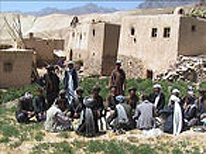 While this money is necessary to fund the reconstruction effort in the beginning of the process, it needs to be issued at a more local level in order to accomplish lasting success. Clare Lockhart, a UN advisor who helped set up the National Solidarity Program (NSP), pointed out that donations given to the government position the citizens as “passive recipients”(Rich, par.5) and most of the time, do not reach the village level after trickling through the government hierarchy. Other resources need to be handed out evenly to villages where the people can see the improvements and have a hand in the reconstruction. With the goal to “promote village-level, community-run development programs . . . that can grant [Afghanistan villages] access to resources, (par 2)”, the NSP has stimulated vast improvements since 2001. However, the benefits did not stem from the aomunt of money given to the nation as a whole, but how it was allocated amoung the lower levels of government. Resources are issued, but at the village level, allowing the citizens to have a direct impact on their surroundings. They see the improvements and from this, gain motivation to do more. They realize they can take a more active approach in renovating their own environment. Many more benefits result from this distribution of resources, but the most important result is the “bottom-up governance structure (par 11)”. Villages meet together, of their own accord, to combine their resources and plan for joint improvements, such as irrigation and road construction. In turn, the entire country is helped, one village at a time.
The following quote from a citizen in Afghanistan sums up the solution to the problem of reconstruction: “Before the program came along, we were sitting in a heap," (this is in a village that was literally a pile of rubble, where the villagers just returned from exile) "Then the facilitator came along and we began to get up off the ground and organize ourselves. It was not so much the money -- although that was helpful -- but the fact we began to collaborate and talk to each other to work out what to do.” (Rich, par 16)”. It is not the money that rebuilds the nation-- it is the people. Handing out money will only continue reinforce a state of helplessness and dependency. Lending money at a local level will help establish more programs that aim to help the people help themselves and find self-reliance.
Works Cited
"Afghan Turmoil." Reuters Alertnet Foundation. 28 Mar. 2008. 1 Apr. 2008 <http://www.alertnet.org/db/crisisprofiles/AF_REC.htm>
Delong, J. Bradford. "Slouching Towards Utopia?: the Economic History of the Twentieth Century." The Economic History of the Twentieth Century. Feb. 1997. UCBerkley. 3 Apr. 2008 <http://econ161.berkeley.edu/TCEH/Slouch_Present19.html>.
Life on the Edge. 2007. YouTube. 3 Apr. 2008 <http://www.youtube.com/watch?v=mmG2bH3YQVc>.
"Return to Afghanistan." UNHCR. 2001. 29 Mar. 2008 <http://www.unhcr.org/cgi-bin/texis/vtx/afghan?page=home>.
Rich, Sarah. "Afghanistan's Solidarity Program." World Changing. 17 July 2007. 9 Apr. 2008 <http://www.worldchanging.com>.
Serafino, Nina, Curt Tarnoff, and Dick K. Nanto. United States. Cong. U.S. Occupation Assistance:. 23 Mar. 2006. 3 Apr. 2008 <http://fas.org/sgp/crs/natsec/RL33331.pdf>.