 d’s superpowers.
China’s history always included agriculture. Several Dynasties rose and fell over rebellions starting from land and farming. In general, emporers forgot or mistreated farmers, despite any promises they made while gaining power.
Communism reformed China’s agricultural industry beginning in 1949. However, capitalist-like reforms over the past 30 years brought amazing growth to urban China. After years of ups and downs, China’s economy now continues to grow at roughly 10 percent per year, making it one of the world’s superpowers.
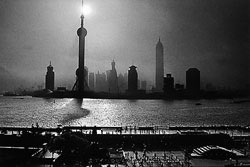
This rapid growth occurred mostly in China’s industrial centers, motivating millions of poor farmers to migrate to cities hoping to share part of this new urban wealth. Unfortunately, many rural Chinese still live in poverty and millions of migrants struggle to survive in cities like Shanghai (pictured on the right).
To understand the complex issue of China’s urbanization, I explored China’s political and economic history, and the current effects of migration in both rural and urban areas.
Ancient History
The earliest dynasties date back to 2000 BC, according to an online student Thinkquest project, and were driven largely by agriculture . The Zhou dynasty, which ruled from about 1250 to 250 BC, divided China into agricultural territories controlled by landlords. Peasants worked on their assigned plots, as well as on other plots, where they worked for the landlord.
Near the end of the Zhou dynasty, landlords began claiming their territories as their own independent states. As these states warred among themselves and with the old dynasty, Qin Shihuang began uniting China and took over the divided kingdom. His dynasty changed China dramatically with ambitious ideas and brutal means of accomplishing them. Qin built the Great Wall of China and other great structures, burned most of China’s books (to begin history with himself), and took little thought for the value of human life (thousands died working on his projects). Western civilizations discovered China during this period and began calling the land "China" after Qin’s name. Qin died and the dynasty following him ended with a peasant-led revolt against high taxes. The next dynasty, around 10 AD, also ended in revolt. Many more dynasties and rebellions occurred over the next nearly 2000 years.
Modern History
The last official dynasty, the Manchu or Qing dynasty, fell Europeans began trading with Asia. Britain introduced Opium to China in the 1800s as a strategy to secure trading power in Asia. The Opium War followed and China lost.
Sun Yat-Sen, an American-educated Chinese reformer, led a revolution that overthrew the deteriorating Manchu dynasty and formed the Republic of China in 1911. Although an attempt at democracy, the new government was unstable and many leaders were corrupt. For about 20 years China had no goverment, only warlords who divided the land and governed independantly. Sun Yat Sen's followers, the Nationalists, along with a new communist movement tried to unite China again as one country. Leon Poon, a graduate student at the university of Maryland, explained that after devastating battles with Japan during World War I and II support for the Nationalists dwindled. In 1949, Mao Zedong and the People’s Liberation Army (communist) beat the Nationalists and established the People’s Republic of China. The Nationalist government and its supporters fled to Taiwan and pronounced Taipei the “temporary” capital of the Republic of China.
The People's Republic of China
Mao inherited China as an economic disaster and communism quickly gained popularity by lifting Chinese farmers out of poverty and instituting social programs which provided housing, food, and stable economic classes. Mao created a household registration system, hukou, dividing China into rural and urban classes. (Pannell 1579)
The hukou system gave individuals assigned careers and places to live. This provided benefits specific to rural and urban people and their needs and ensured that China had a balanced workforce that would help its economy. China granted people the freedom to move around the country only after Mao’s death in 1976, although the old hukou classifications remainded. Rural workers who moved to cities did not have access to benefits such as health care, education, and subsidized housing, which registered urban families received. (Wang and Zuo 279)
Millions of these migrants live in squatter towns on the outskirts of big cities. Guangzhou, a city east of Hong Kong, has an official metro population of 8.5 million, but some estimate it at over 12 million when including unregistered migrants. With more migrants coming, competition for jobs is rising, and so is urban unemployment. As second-class citizens, migrants have a huge disadvantage to locals. (Pannell 1579)
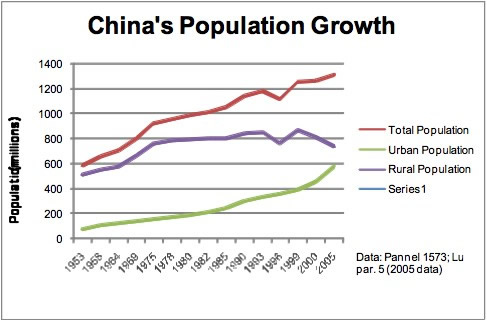
From 1953 to 2000, China’s urban population grew from 78 million to over 455 million, an increase from 13 percent to 36 percent of its total population. The urban population grew by 67 million from 1999 to 2000 alone. (Pannell 1573) Today, China's urban population is 577 million, or 44 percent of China's 1.3 billion people. (Lu par. 5)
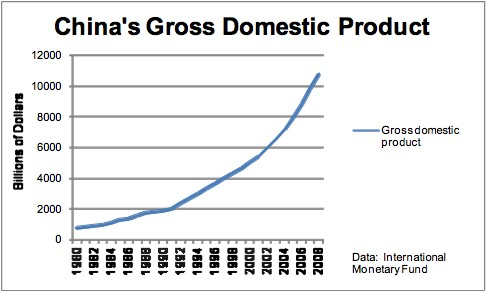
China’s Gross Domestic Product grew by roughly 10 percent every year since 1980, according to the International Monetary Fund. During the 1980s, China cut its poverty level by 25 percent. However, this decrease in poverty probably did not come from major investments of government money, but by reforms such as allowing privately-owned land and businesses. Experts believe that most of the poverty level decrease came easily after fixing old, failed policies. After these simple reforms were complete in the 1980s, China’s poverty reduction tapered off to a very slow decline. (Ravillion pars. 4-6)
Although communism attempted to destroy poverty and social classes, growth in urban areas over the past 30 years brought back the same inequality levels that existed in 1930s China. Jobs are rationed because only the most priviledged get to leave the farms to receive a high school education and higher-paying jobs. (Benjamin and Brandt 293-294)
Many of China's rural poor are stuck in "chronic poverty". They have no way to escape and will continue to scrape by on tiny plots of land, often in mountainous areas where good land is scarce. (Calandrino and McCulloch 619) Family situations also affect rural poverty levels. Some families have husbands or fathers who send money home from their migrant jobs in the city to support their wives and children. Some women are widowed, and have no income except what their farm brings in. Other factors, including education levels, household sizes, value of property and possessions, and illiteracy, also affect rural poverty. (Calandrino and McCulloch 621-623)
Most migrants have more education than average rural workers, according to a scholar at Beijing University. (Zhao 771) If this is true, then China’s rural regions lose some of their most qualified workforces to temporary migration. These workers cannot stay at home long enough to assist development there. Even if they stayed, China does not have enough industrial jobs in rural towns to provide work for all its migrants.
Cities rely on unstable migrant forces to meet labor demands, so China needs migration. However, migrants cannot contribute positively to the social or economic development of either their rural home towns or the cities that they work in. They only temporarily fill their need for money and cities’ need for quick production and construction, and will not fix any long-term problems.
A surplus of rural workers and a shortage of consumer goods led the government to lift migration restrictions and allow workersto move into the cities about 30 years ago. On average, migrants at least double their income from what they earned in the rural communities they came from. (Wang and Zuo 276) Migrants can't stay, though. Their rural hukou registration prevents them from establishing themselves permanently without a lot of difficulty.
A rich migrant can buy an urban registration for about 1 million yuan ($200,000 US), roughly 150 years wage for an average rural worker. Even with this million-yuan paper, most jobs in China are given through government programs, or friends or relatives. Migrants are not part of these social groups. Also, programs to reduce unemployment among urban residents prevent employers from hiring migrants for many jobs. (Wang and Zuo 279)
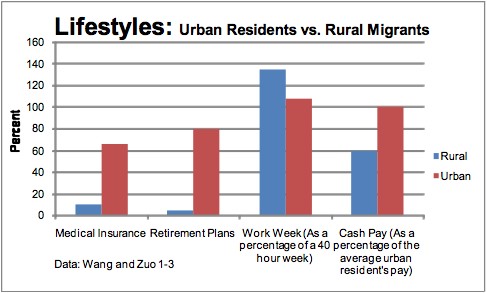
A quarter of Chinese urbanites work in professional, medical, or government jobs, but only three percent of rural migrants work in these “white collar” fields. They take the jobs other people don’t want, like manufacturing, service, or construction. Even after leveling out education, sex, and other factors, urban residents still are three times as likely to hold white collar jobs. (Wang and Zuo 277)
Urban also residents earn 40 percent more than rural migrants and receive “various in-kind incomes such as heavily subsidized housing, food provided at the workplace, childcare, transportation, and entertainment.” Urban workers work an average of 43 hours per week, while rural workers work an average of 54. (Wang and Zuo 277-278)
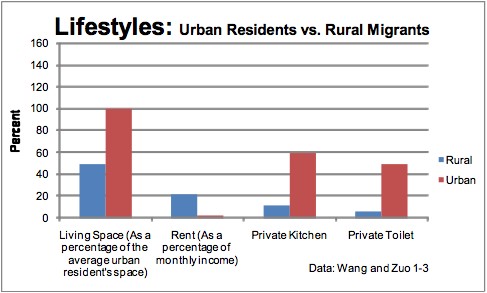
Most rural migrants are men who are either single or leave their families at home while they work. In Shanghai's migrant communities, “Out of the 64 percent who are currently married, only one out of every five has a spouse also in Shanghai.” (Wang and Zuo 279) Migrant and urban populations separate socially as well. “The stereotype of rural migrants is that they are uneducated, ignorant, dirty, and also have high propensities to be criminals.” (Wang and Zuo 278)
China’s migration is a temporary cycle, rather than a permanent move. A 1995 survey in Shanghai showed that only about a third of migrants wanted to stay in the city, “if possible.” The rest were either unsure, or planned to return home. (Wang and Zuo 279) Nearly 75 percent of migrants stay for one year or less. (Zhao 770)
The exponential growth of China’s urban population and the matching drop in rural population might actually be much higher than statistics show. Because temporary migrants are difficult to keep track of—because they are not allowed to settle permanently—an exact count or reliable estimate is not possible.
China must develop programs and industries in rural areas to provide equal opportunities and money for potential migrants to motivate them stay near their homes and build local economies. China must also admit their dependence on migrant workers and provide them with opportunities and rights to live comfortably with their families as part of urban communities. These programs will take a lot of funding, which will slow China’s 10 percent GDP growth per year. However, China needs to slow down and catch its breath before the problems created by rapid growth—such as temporary rural migration—cause an economical collapse or a revolt like the ones which ended so many dynasties in Chinese history.
The communist revolution of 1949 brought in programs aimed to help peasant farmer and poor workers and to prevent an elite social class from forming. Today, these same programs seem to keep peasants in poverty and prevent the poor from becoming successful, protecting China’s new “elite” urban classes.
Benjamin, Dwayne and Brandt, Loren. “Markets and Inequality in Rural China: Parallels with the Past.” The American Economic Review 89 (1999): 292-295.
Calandrino, Michele and McCulloch, Neil. “Vulnerability and Chronic Poverty in Rural Sichuan.” World Development 31 (2003): 611-628.
International Monetary Fund. “Report for Selected Countries and Subjects.” World Economic Outlook Database. October 2007. International Monetary Fund. 3 Apr 2008. <http://www.imf.org/external/pubs/ft/weo/2007/02/weodata/weorept.aspx?pr.x=52&pr.y=10&sy=
1980&ey=2008&scsm=1&ssd=1&sort=country&ds=.&br=1&c=924&s=NGDP_R%2CNGDP_
RPCH%2CNGDP%2CNGDPD%2CNGDP_D%2CNGDPRPC%2CNGDPPC%2CNGDPDPC&grp=0&a=>.
Lu, An. "NBS: China's rural population shrinks to 56% of total." Window of China. 22 Oct 2007. Xinhau Net. 3 Apr 2008.<http://news.xinhuanet.com/english/2007-10/22/content_6925292.htm>
Pannell, Clifton. “China's continuing urban transition.” Environment and Planning A 34 (2002): 1571-1589.
Poon, Leon. “History of China.” The Chaos Group at Maryland. University of Maryland. 3 Apr 2008. <http://www-chaos.umd.edu/history/toc.html>.
Ravillion, Martin. “Fighting Poverty: Findings and Lessons from China’s Success.” Research at the World Bank. The World Bank. 3 Apr. 2008. <http://go.worldbank.org/QXOQI9MP30>.
Thinkquest. “Chinese Dynasties.” Thinkquest Library. Oracle Education Foundation. 3 Apr 2008. <http://library.thinkquest.org/12255/library/dynasty/dynasty.htm>.
Wang, Feng and Zuo, Xuejin. “Inside China's Cities: Institutional Barriers and Opportunities for Urban Migrants.” The American Economic Review 89 (1999): 276-280.
Zhao, Yaohui. “Labor Migration and Earnings Differences: The Case of Rural China.” Economic Development and Cultural Change 47 (1999): 767-782.