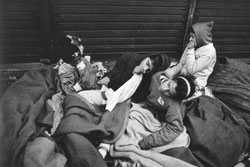
The streets of Brazil are overwhelmed by unsupervised and unprotected children. There have been several different assessments and measurements taken concerning this issue, but current estimations indicate that there are 7-8 million youth who are homeless in Brazil, ranging from ages 5 to 18. The difference between these youth and many of the other homeless youth in the world is that they are highly discriminated against by most of Brazil’s population and are targets of gang violence, highly addicted to drugs, and perpetually exploited and abused.
There are several reasons why these children end up on the streets of Brazil instead of remaining in their homes. Perhaps the main reason they leave home is because of physical, emotional, or sexual abuse going on within their homes. Another reason why youth leave home is because their families are tobrazil Sebastiao Salgadoo poor to take care of them and they feel they are a heavy burden to their parents. This is especially true because of the distinct social classes of Brazil. 1/3 of Brazil’s population lives below the poverty line and this severe separation forces many impoverished youth to run away from home in order to sustain their families. Several other factors including mental health, drug addiction, and maltreatment could also force a child to leave their home and begin life as children of the streets.
James A. Inciardi in his article, “Children in the Streets of Brazil”, makes a clear distinction between children on the streets, and children of the streets. Children on the streets he says, often live at home, or with a parent, but are sent to the streets to beg for money, or sell cheap supplies such as cigarettes, newspapers, or flowers. These children on the streets are not the ones that are a concern, according to Inciardi. However, children of the streets have severed almost all ties with their families. These are the youth that have had to leave home due to hunger, maltreatment, or poverty, and who feel that life on the streets is easier and preferable to a life of burden. These are the youth that are discriminated against so heavily in the Brazilian culture and who are the targets of gang violence and police action. Often these youth turn to theft, drug sales, and prostitution in order to survive – whereas children on the streets are selling legally.
While the majority of children of the streets are males, there are approximately 800,000 young girls who live on the streets of Brazil. These girls are at an even bigger disadvantage than the males who are on the streets. They are constant victims of sexual and emotional abuse and the Brazilian government estimates that 2/3 of the 800,000 girls of the streets are working as prostitutes in order to survive (Inciardi p.1). These young girls are often the most highly discriminated against because of their moral behavior and are ridiculed and exploited on the streets because of their means of surviving.
Over the past few decades, many of the young street children have been getting negative attention instead of compassion by their fellow Brazilians. In the 1970’s-1990’s, most of the children on the streets were called abandonados, or children who are abandoned with nowhere to go. Now, most of the names that the Brazilians are calling these youth are anything but sympathetic. The names gamines (urchins), and marginais (nonessentials or criminals), are becoming much more common in the colloquial Brazilian speech. This negative attitude towards these youth is provoked from fear and mistrust for these children as crime and prostitution has risen drastically in the streets as the population of the children has also grown. However, not everyone has a negative attitude towards these misplaced children. Nancy Scheper-Hughes, a researcher of homeless Brazilian youth describes them as, "poor children in the wrong place” (Inciardi p.1). Unfortunately, most Brazilians do not view these youth as “poor children”, but instead as menaces and a threat to their safety and society.
Drug use is a major reason why many Brazilians mistrust the children of the streets. There are several drugs that are highly addictive to these youth that are becoming increasingly common. Coco paste, a popular drug, can be smoked straight, or mixed with tobacco and marijuana. The reason coco paste has spread so drastically is because it is the cheapest form of cocaine possible. It is readily available, absorbed quickly, and relatively inexpensive. The effects of the drug are an intense high, which helps numb feelings of pain and hunger. The high also impairs judgment removing any feelings of guilt or refrain from committing acts of prostitution and theft. In essence, drug use becomes a form of escape from the reality of their harsh lives.
Coco paste, however, is not the only form of drugs that is used on the streets. There are many inhalants that are being used that are causing a major influx of mental problems and handicaps among these youth due to the dangerous and very addictive chemicals. Some of these chemicals include but are not limited to: glue, lighter fluid, and gasoline. When there is no coco paste or marijuana readily available, many children turn to the use of these dangerous inhalants, as a cheap form of getting high – despite their dangerous and inevitably, deadly effects.
The Guidance Center on Drugs and the Treatment of Drug Addicts of the University of Brasília, conducted a study in 1992 among street youths. Although the sample size was relatively small, the results were shocking. Of the youth studied who lived on the streets, a full 100% of these youth admitted to being addicted to inhalants or other forms of drugs, and were completely dependent on these drugs for their well being. Most of these street youth admitted to being addicted mainly to inhalants, such as glue or gasoline, because it is the cheapest way to get a high.
Drug problems are not the only rampant problems among these street youth, however. Inciardi’s research reports that in 1992 there was a study regarding sexual behavior that had shocking and frightening results: “A study of 62 children found that 48.4% had engaged in sex, 60% with adult men, 16.6% reported sex for money, but only 33.3% reported any use of condoms.” This epidemic of risky sexual behavior especially among females on the streets is an increasing problem. 44.4% of the children interviewed in the above study reported being forced to have sex, or being raped. This unprotected sex additionally, is leading to an even bigger problem: HIV.
The World Health Organization reports that between 50,000 and 100,000 children on the streets are currently HIV positive, and that the number is growing increasingly larger. Although the numbers are growing, lack of education regarding the disease and ways to prevent it are spreading the disease even more. The above study also stated that 94% of these street youth admitted to HIV risk behaviors, even if they are not currently HIV positive. Another 43% of interviewed youth reported heterosexual intercourse as being common in their daily behavior.
Although there are many overwhelming issues regarding the children of the streets in Brazil, there are several factors being taken by the government, as well as NGO’s (Non-Governmental Organization) to suppress the problems. Reform schools, rehabilitative services, as well as education and counseling among the street children are becoming more common, and much more acceptable to the Brazilian society. By instituting these measures, the children may feel that they have somewhere to go and a support group of adults who are ready to see a change in their streets. By supporting these institutions, but even more importantly, helping to change the attitude towards these poor youth may be the most important yet difficult measure taken to improve the lifestyle of these children. By positively looking forward to a change in the streets of Brazil, there is a higher likelihood of their survival and success.
Downie, Andrew. "Brazil's Drug Users will get Help instead of Jail." The Christian Science Monitor (Jan. 2002). 4 Apr. 2008 <http://http://www.csmonitor.com/2002/0104/p7s2-woam.html>.
Inciardi, James A, and Hilary L Surratt. "Children In The Streets Of Brazil: Drug Use, Crime, Violence, and HIV Risks." Substance Use and Misuse (1997). 4 Apr. 2008 <http://http://www.udel.edu/butzin/articles/child.html>.
Mueller, Karine. "Brazil's New Drug Law." The Narco News Bulletin 17 May 2004, Latin America ed. 4 Apr. 2008 <http://http://www.narconews.com/Issue32/article928.html>.